
"Rúben Amorim... The Tactical Gem of Portugal: A Numerical and Tactical Analysis of the Portuguese Coach's Style"


In just a few years of management, Rúben Amorim has become one of the most highly rated and sought-after young coaches in football. After starting his managerial career at Casa Pia in the Portuguese third division in 2018, Amorim got his first big opportunity when Braga appointed him as their B-team manager. Just three months later, following the dismissal of Ricardo Sá Pinto, Amorim took charge of the senior team at Braga. At just 34 years old, he was managing a team in one of Europe’s top leagues.
Amorim impressed Sporting CP so much during his time at Braga, where he won 10 of the 13 matches he coached, that they contacted him. In March 2020, they paid a significant fee to buy Amorim out of his contract with Braga. Remarkably, in his first full season at the club, Amorim led Sporting to the domestic double, including their first league title in 19 years. Sporting suffered only one loss in the league that entire season, and that defeat came in the 33rd match out of 34, after they had already secured the title. Amorim's attractive and effective style of football has delivered quick results and led to links with some of the biggest European clubs. It seems unlikely that his work at Sporting is over, though he will also be aware of the clubs that have been linked with him, possibly having aspirations to manage in the Premier League one day (with reports linking him to a move to Chelsea or Liverpool at the start of next season). Here, we take a closer look at Amorim's tactical style with Sporting.
Mancini from The Athletic said: "His superpower is not the 3-4-3 formation, but his communication with fans, the media, and players." He continues by saying that Amorim is a natural leader, incredibly hardworking, and has excellent communication both externally and internally. He is someone with an immense desire to win and is focused on teamwork, which is a core part of his philosophy.
Let's take a closer look at Sporting Lisbon's season in the Portuguese league so far.
The team currently sits in second place, just behind leaders Benfica, but with one game less than them. Sporting has played 22 matches, winning 18, losing 2, and drawing 2, accumulating 56 points so far.
The team has scored 63 goals, making it the most potent attack in the league, with an expected goals (XG) value of 47.3.
Defensively, Sporting ranks as the third strongest defense in the league, after Benfica and Porto, having conceded 22 goals to date.
In the UEFA Europa League, the team is set to face Atalanta in the Round of 16 after finishing second in their group and advancing from the knockout round against Young Boys.


Build-up Play in Amorim's Tactics
Amorim's preferred formation is 3-4-3. Under Amorim, Sporting built from the back using a 3-1 structure, with Oğartı acting as the sole pivot. However, it was often difficult for the full-backs to provide width, especially when opposing teams pressed high, which forced Sporting to compress the play in areas around Oğartı. This didn’t necessarily stop them from obtaining possession, but it did limit their ability to progress the ball effectively and find passing lanes.
This season, we've seen a slight change in the build-up process. In the early stages of possession, Amorim's team has adopted a double pivot system, with Pedro Gonçalves dropping deeper to assist in creating overloads in the first phase of build-up. The full-backs, typically left-back Reis/Santos, stay wide, helping to stretch the pitch in high areas or around pressing zones, allowing for more fluid transitions and better exploitation of space.
The passing map for Sporting Lisbon this season confirms what was mentioned earlier. The team’s structure with three central defenders is evident, and the full-backs are indeed playing as wide players on the flanks, working in high areas of the pitch to stretch the field. This wide positioning allows for better manipulation of space, especially when the team looks to break opposition lines.
Moreover, the passing map clearly shows that Sporting relies heavily on the left side in their ball progression, which aligns with what was previously noted. This focus on the left side, especially with the involvement of the left-back and the drop of Pedro Gonçalves to create overloads, facilitates better passing lanes and allows Sporting to exploit the weaker areas of the opposition's defensive setup. This strategy helps in maintaining a fluid build-up while also making the most of available spaces.
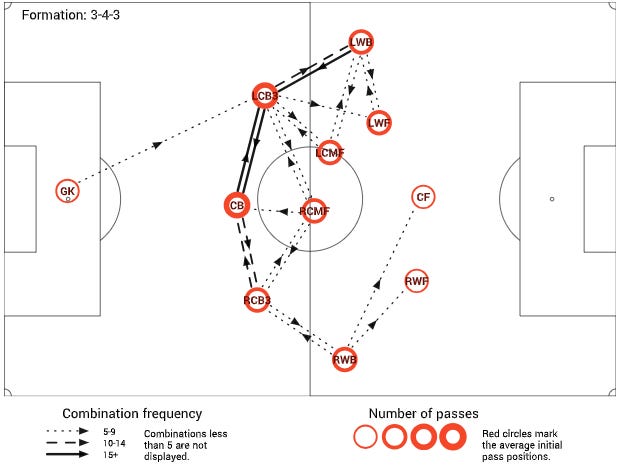
Amorim has made adjustments to his playing style from last season to adapt to the ongoing changes in the league and the modifications within his squad. One significant change has been his preference for utilizing the central defenders in a slightly different manner than in previous seasons. Typically, Coates or Diomandé, who is more suited to this role, moves into the midfield, allowing the double pivot to drop deeper towards the center-backs. This movement gives the other defenders the freedom to spread wide and stretch the pitch.
This approach is one of Amorim’s tactical solutions to escape pressure and progress the ball from defensive areas. By shifting the center-backs into more advanced positions and widening the structure of the team, he creates more options for ball progression, reducing the risk of being pressed while maintaining control and fluidity in build-up play. This also helps the team break the opposition's pressing lines and exploit spaces in the attacking third.


Essentially, what this adjustment does is expand the distances that the opposition must cover during the pressing process, increasing passing options and creating more angles for the ball carrier. Diomandé, in particular, feels comfortable receiving the ball with his back to goal, where he acts as a pivot for play or as a player capable of turning under pressure to carry the ball and break the opposition's pressing lines.
By widening the space between the outside center-backs in the three-man defense, it allows the full-backs to position themselves higher up in the opponent's half. Meanwhile, the central midfielders drop deeper, creating huge spaces in the left and right channels, which are then exploited by the wingers who play in roles similar to number 8s or 10s. This is a smart tactical move from Amorim, as it uses the space effectively. The tight positioning of the three forwards also provides substantial attacking and build-up benefits.
Amorim places significant responsibility on the full-backs, who are tasked with widening the pitch. This gives them greater control from deep, enabling them to break lines and carry the ball through various stages of the play. Inácio and Diomandé are perfectly suited for this role, as they are comfortable in deep areas and effective at progressing the ball, making them crucial to this build-up process.


The 2-4 build-up structure is also utilized when the left-wingback plays as a full-back. Amorim has shown great flexibility within his principles, able to adjust the build-up approach based on the available players. Despite losing Diomandé to the Africa Cup of Nations, selling Oğartı, and dealing with the departure of Nunes, Amorim maximizes the resources at his disposal, adapting his methods accordingly.
However, this does not mean that the build-up play solely depends on the quality of their defense (although it certainly helps). The repetition of patterns is a clear indication of focused training on specific patterns during the build-up process, with small adjustments made to generate momentum and success. Even in the absence of certain players, the general build-up style remains largely unaffected, which is a testament to Amorim's tactical work.
When building from the deeper stages of play, the team operates in a 3-2 or 3-2+1 shape, but once they surpass the first line of opposition pressure, the team transitions to a 3-2-5 formation in the second phase. The five-man front line occupies all five channels, with Edwards and Trincão, in particular, receiving the ball between the lines, moving into traditional playmaker roles, akin to number 10s. This strategic positioning helps Sporting maintain fluidity and creativity in the attacking phase while ensuring the team remains structured.
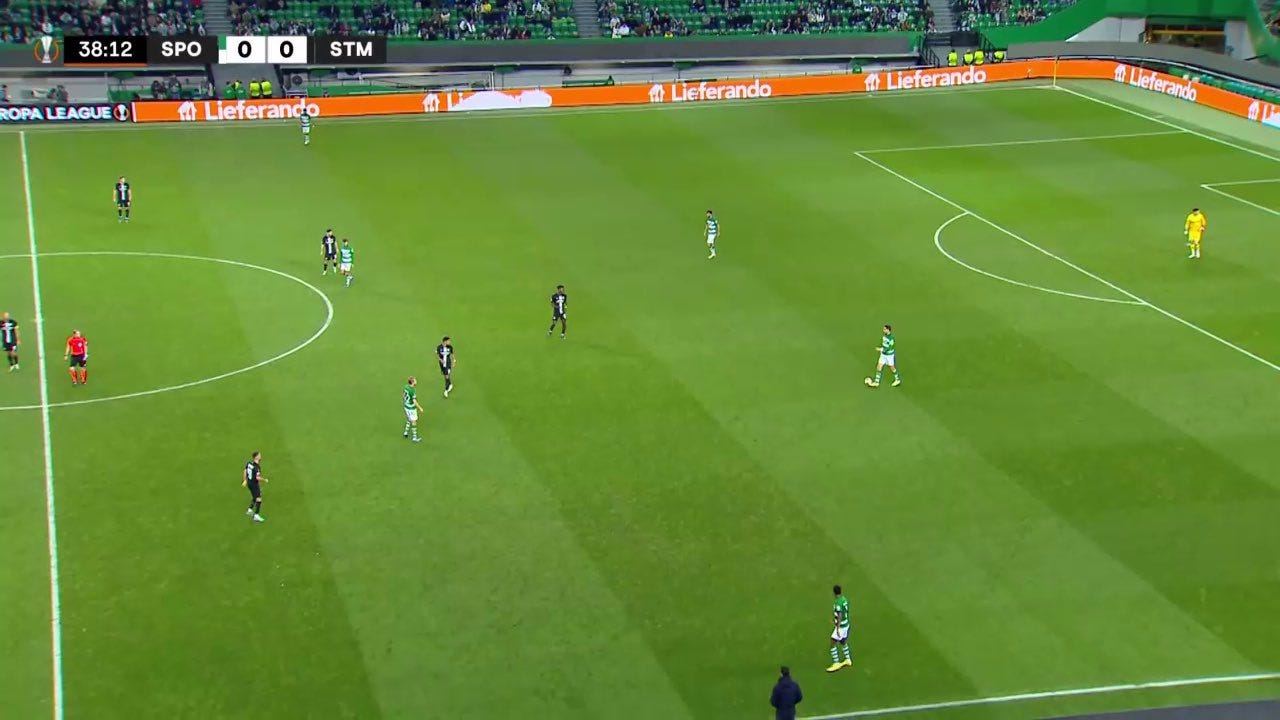
Sporting can be a very direct team, using pressure to their advantage by dropping their double pivot deeper and widening the defense to its full extent. With no explicit number 10 and the presence of a deeper midfielder, this setup creates space for the central striker to engage in areas where they can receive long passes from the goalkeeper.
A crucial element of Amorim’s style is the need for a goalkeeper who is skilled with the ball at his feet, as this allows the team to transition quickly and accurately from defense to attack. Additionally, having a physically strong central striker who excels in aerial duels is key to maximizing the effectiveness of this direct approach, enabling the team to compete in second-ball situations and win important duels. This combination of technical and physical attributes ensures that Sporting can not only build from the back but also transition quickly into attack when the opportunity arises.
As mentioned earlier, Amorim tends to favor the left side in the build-up phase, but there is a clear bias toward the right side in the final third. The right-back occupies the width of the pitch, while Trincão is allowed to drift more centrally. The left-winger moves inside to become the central striker when Jovane Cabral drops deeper to link up play.
Pedro Gonçalves pushes forward to create overloads, which forces the opposition’s full-backs to retreat into the midfield. This opens up space for Santos, who is then completely free on the opposite flank. This tactical movement not only stretches the opponent’s defense but also creates dynamic attacking options, allowing Sporting to exploit spaces both centrally and on the wings. The flexibility of the wingers and midfielders allows Amorim's system to keep the opposition on their toes and generate attacking opportunities from multiple areas of the pitch.
The compactness in Sporting's attacking play grants additional freedom to the full-backs, especially Nuno Santos. With Paulinho and Gonçalves often playing as inverted left-wingers or dropping deeper, they pull defenders away from certain areas, creating space for Santos to exploit. Santos is particularly effective in this role, as he possesses an excellent ability to break pressure with passes, often making incisive passes into the box. He consistently attacks the six-yard area with his crosses and passes from the flanks.
This is a key tactical feature that Amorim employs with his wide defenders: pushing forward to increase the width of the defense and creating options for vertical passes into advanced areas. These backward passes from the full-backs become more frequent as the team moves upfield, reinforcing the idea of breaking lines and stretching the defense. By utilizing this fluid approach, Sporting can maintain pressure on the opposition while opening up spaces in critical areas, especially around the box.


When building attacks, Amorim's style is flexible and adaptable based on the available players. He often employs a diamond shape in midfield to create better passing opportunities from the full-backs into central areas. This structure allows for more fluid transitions and facilitates control of the central spaces, creating more options for progress and breaking through opposition lines.
However, we haven't seen this adaptation in his 3-4-3 system since he transitioned away from using a single pivot. This shift demonstrates not only his tactical flexibility but also his innovative approach to utilizing different systems depending on the circumstances and players at his disposal. Amorim's ability to adjust his tactics while maintaining the core principles of his play is a testament to his growth as a coach and his understanding of the game.
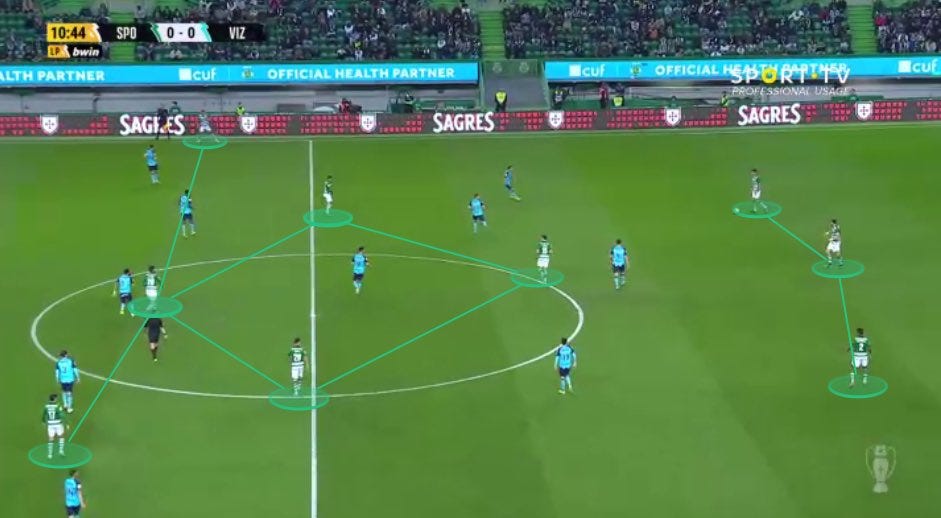
Amorim’s team is known for its aggressive pressing. With an average PPDA of 6.13 this season, Sporting presses primarily in a 4-2-4 or 3-4-3 shape, with the main objective being to protect central areas. The tight front line helps channel the ball towards the opponent's defenders, essentially setting a pressing trap.
The full-backs in Sporting's system are particularly aggressive, pushing high up the pitch to recover the ball in advanced areas. This high press allows the team to win possession quickly and create counter-attacking opportunities. By forcing the opposition into mistakes in high-risk areas, Sporting can exploit the spaces left behind and transition rapidly into attack. This intense pressing style is a key feature of Amorim's tactical setup, reflecting his emphasis on ball recovery and quick transitions.
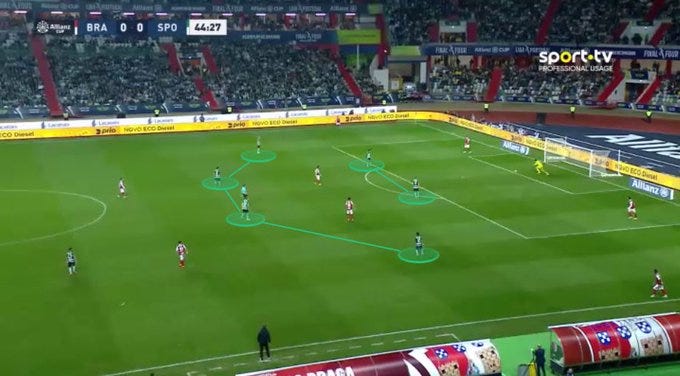
Amorim has no issue reverting to a 5-4-1 shape during low or medium defensive blocks, showcasing his excellent skills in coaching pressing and defensive structures. While he has adapted his style to be more attack-oriented, he considers himself somewhat old-fashioned in that he doesn’t want his teams to dominate possession for possession's sake. Instead, he wants them to control their strengths and impose their best qualities on their opponents. Simply put, if his team plays at its best, both tactically and technically, he believes they can overcome any opponent.
While Amorim’s team is often considered a well-organized, defense-oriented side, this doesn’t fully capture the essence of their play. Are they strong defensively? Yes, but not at the expense of their attacking play. They have been the most prolific team in the Portuguese league this season, scoring 63 goals, while conceding only 22 (the third-best defensive record). Their 8-0 victory is their biggest win of the season, but perhaps the most impressive victory was their 5-0 win over Braga, showcasing both their attacking and defensive prowess in a dominant performance.
Amorim's balance between defense and attack allows his teams to be flexible, whether they're pressing high, defending deeply, or breaking quickly on the counter, ensuring that they remain competitive in all phases of play.
In the match between Sporting Lisbon and Braga, Sporting's build-up in a 3-2-5 formation faced off against Braga's 6-2-2 setup, which presented some interesting tactical nuances.
Sporting’s back three had to cope with a high defensive block from Braga, where Santos and Catamo played more as wingers rather than traditional full-backs. This meant that it was much more difficult for Sporting to progress the ball to their back three, as Braga’s wide players, paired with the two strikers, compacted the spaces and pressured the ball carriers effectively.
Central defender Coates, often the key man in deep build-up play, advanced into midfield. He occasionally received the ball with his back to goal, which created overloads in midfield, as he would drag one of Braga’s forwards out of position. This movement helped to create passing lanes for Sporting, allowing them to break through the initial pressing line.
By pushing forward, Coates also helped pin down Braga’s attackers, making it harder for them to shift into an effective pressing structure. His presence in midfield gave Sporting an extra player to maintain control and dictate the tempo, ensuring that even when Braga's defense was organized, Sporting could still maintain possession and build forward. This was a key part of their ability to break through Braga’s 6-2-2 defensive shape, demonstrating Amorim’s flexibility and how he uses overloads to destabilize the opponent's defensive lines.


Coates seemed to be waiting for the spaces to open up before advancing, often using patience to assess the situation. He would either provoke pressure from Braga by holding his position, drawing opponents towards him, or he would simply wait for the movements of Sporting’s midfielders and attackers to create opportunities. This approach allowed him to assess the timing and positioning of his teammates, ensuring that when he did move forward into midfield, there was either space to exploit or a passing lane to find.
This tactical patience is indicative of Amorim’s preference for controlled progression, where players like Coates take calculated risks rather than rushing forward without purpose. By waiting for the right moment, he could ensure that any forward movement would be supported by his teammates’ positioning and that it would either break Braga’s lines or create overloads in key areas of the pitch. This patient, opportunistic style of play helped Sporting manage Braga's defensive setup and maintain control over the game.


Sporting sought to advance more through the middle by manipulating Braga's man-to-man marking pressure. A prime example of this approach can be seen in the movements of Morita and Gonçalves. Their interplay through reverse runs allowed them to confuse Braga’s defenders and create passing lanes. By swapping positions and making timed movements, they pulled Braga’s midfield and defensive lines out of position, which helped create space for progress through the center.
Additionally, Sporting often tried to establish passing corridors between Braga’s man-to-man pressure. By pulling defenders away with clever runs and positional rotations, Sporting could break the compact lines of Braga’s defense and create opportunities for direct passes into attacking areas. This tactical manipulation of Braga’s pressing system is an example of Amorim’s ability to coach his players to exploit defensive weaknesses and ensure smooth ball progression, even when facing tight defensive structures.


Morita and Gonçalves positioned themselves in the same line as Heulmand, between Braga’s defensive lines, with the aim of creating spaces between Braga's pressing lines and advancing through those gaps. This movement was part of a deliberate strategy to stretch Braga’s defense and disrupt their man-to-man marking.
By aligning themselves in this way, Morita and Gonçalves were able to drag Braga's midfield and defenders out of their usual positions, creating open passing lanes between the lines. This allowed Sporting to bypass the pressure and advance the ball more efficiently. It also made it harder for Braga to maintain their compactness, as the fluidity of Sporting’s positioning forced their defensive structure to shift constantly, opening up spaces for progression through the middle.
The movement between the lines, combined with the positioning of Heulmand, was a tactical maneuver aimed at exploiting any gaps in Braga's defensive setup, allowing Sporting to break through their pressure and transition into more dangerous attacking positions. This is a clear demonstration of Amorim’s ability to manipulate space and timing to outplay opposition presses.


Heulmand's forward movement, along with his role in exchanging positions with Morita, was a key tactical feature in Sporting's play. This dynamic interchange of positions was designed to confuse Braga’s defensive structure and create gaps in their pressing lines. By having Heulmand move into advanced positions while Morita dropped deeper or moved into the same space, they disrupted the tight man-to-man marking system that Braga used.
The primary goal of these movements was to stretch Braga's defensive lines and create moments of disorganization. As Heulmand and Morita swapped roles, Braga’s defenders were forced to make decisions about whether to follow their man or to cover space, which often led to confusion and openings. These gaps allowed Sporting to progress the ball more easily through the middle, bypassing Braga’s press and creating opportunities to advance into dangerous areas.
This fluid movement between Heulmand and Morita is a testament to Amorim's ability to coach players to execute complex, yet effective, positional rotations. By creating these dynamic exchanges, Sporting was able to control the game’s tempo and penetrate Braga’s defensive system.


Morita and Heulmand, by positioning themselves strategically, effectively pinned down Braga’s midfielders while also expanding the space between them. This created a clear passing lane to any of Sporting’s three attackers — Gonçalves, Júnior, or Trincão. Their movement in this phase of build-up play was designed to draw Braga's midfielders out of position, thereby opening up the central and wide passing options.
This is one of Amorim's key ideas in developing attacks in the second third of the pitch. By stretching the opposition's midfield, he facilitates the creation of space for the attacking trio, enabling them to receive the ball in more dangerous areas. This also disrupts the defensive structure of Braga, as the midfield and defensive lines are forced to adjust to the fluidity of Sporting’s positioning.
In essence, Morita and Heulmand's role is not only to advance the ball but to act as decoys, manipulating Braga’s press and creating passing lanes for the attacking players, which is a crucial part of Amorim’s tactical approach to moving through the middle third.
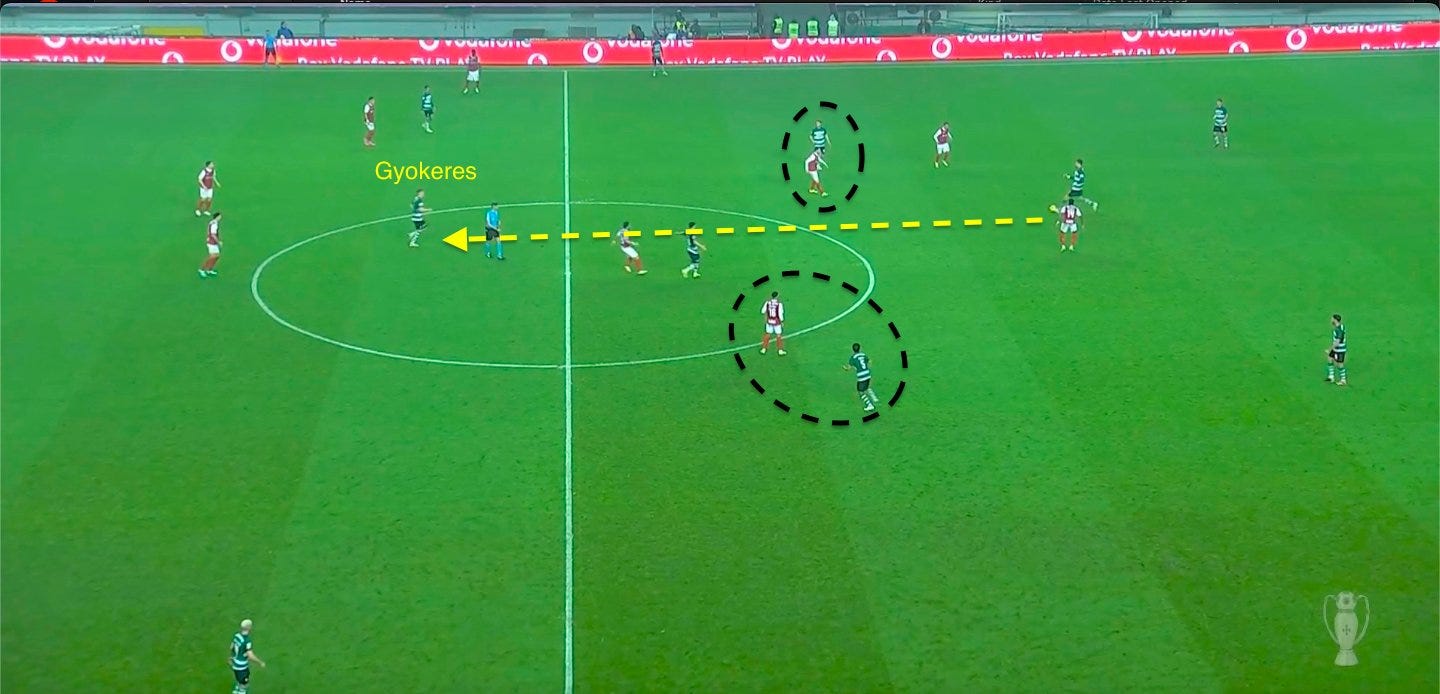
In this situation, Morita’s movement towards Heulmand was intentional, as it created the necessary space for Coates to carry the ball forward. By drawing Heulmand closer and shifting the positioning in the midfield, Morita facilitated a gap that allowed Coates to step into the space and progress the ball more freely. This action is part of Amorim's tactical flexibility and his approach to breaking through the middle third of the pitch.
Amorim's flexibility in possession phases is evident here, as he encourages fluid movement between players to create new passing lanes, exploit gaps, and disrupt the opposition’s defensive structure. The idea is to create overloads in key areas, which then allows players like Coates to move forward with the ball or find a pass that breaks the opposition’s lines.
This dynamic use of space, combined with the positional fluidity of the players, is a key feature of Amorim's tactical setup. By ensuring that his players are not rigid in their positioning, but instead constantly adapting and rotating, he creates multiple options for advancing the ball and creating attacking opportunities.


Morita, in particular, appeared bolder in pushing forward compared to Heulmand, who mostly remained central to provide coverage for the advancing full-backs during possession. This tactical distinction between the two midfielders is a deliberate design by Amorim to ensure balance and fluidity in build-up play.
While Morita made more forward runs to help break the lines and add an additional threat in attack, Heulmand’s role was more defensive and stabilizing. By staying central, Heulmand provided support for the backline and the full-backs as they pushed higher up the field. This setup allowed for a dynamic shift in the team’s offensive structure — with Morita offering direct vertical progression and Heulmand maintaining positional discipline to cover potential counters or defensive transitions.
This tactical balance between Morita's boldness and Heulmand’s stability ensures that Sporting can press forward efficiently while keeping their defensive shape intact, demonstrating Amorim’s emphasis on versatility and the smooth integration of both defensive and attacking responsibilities.


This is another key tactical concept from Amorim's system: exploiting space in the internal wide channels through the full-backs, particularly by using Coates to carry the ball. By advancing the ball centrally and attracting Braga’s attackers to press him, Coates effectively "provokes" the press, creating opportunities for other players to exploit space.
Once the pressure is triggered by Braga's forwards, Coates can either switch the play to the wings or make a vertical pass through the central corridor to an attacker. This is followed by quick transitions, where the ball is moved to the flanks, often into advanced, unmarked positions. The idea is to force Braga's defensive structure to shift and create openings for the full-backs, who are now positioned in high areas of the pitch without direct marking.
This movement exploits the overloads in the middle and uses the full-backs' advancing runs as a key weapon to stretch the defense. The fluid transition from central to wide play, combined with the strategic positioning of players, makes it very difficult for Braga to maintain a cohesive defensive shape. Amorim's ability to manipulate space, pressure, and timing allows Sporting to break through high defensive lines and create dangerous attacking situations.


The second goal against Braga perfectly illustrates the dynamic nature of Amorim's tactical setup during possession. In this instance, Fábio Coentrão (who is often the one operating as a full-back in high areas) carried the ball forward to bypass Braga's pressing lines. His quick, decisive pass to Trincão allowed the attack to flow into the final third, but Coentrão's involvement didn’t stop there.
After the pass, Coentrão continued his run into the box, mirroring the fluid movement often encouraged in Amorim’s system. Gonçalo Guedes, playing a central role, then made a smart movement inside the penalty area, becoming the focal point of the attack. When Guedes’ effort faltered, Coentrão’s relentless run allowed him to collect the ball and score, demonstrating the importance of tracking runs and maintaining offensive pressure.
This goal encapsulates Amorim’s tactical emphasis on fluid movement, where players are not static in their positions. The dynamic interplay between full-backs, wingers, and central attackers in high spaces — constantly interchanging and creating overloads — makes Sporting a formidable force in transition. The goal also showcases how Coentrão’s decision to push forward didn’t just add width but created a vertical option for deep, penetrating runs into the box, further destabilizing Braga's defensive structure.
The third goal is another great example of Sporting exploiting the internal wide channels to devastating effect. In this instance, Coentrão once again played a pivotal role in carrying the ball forward, seeking to break through Braga's defensive shape. He found Trincão, who made a smart run into the space between Braga's centre-back and left-back, a space that is often created through the positional rotations and the overloads Sporting generates.
Coentrão then continued his movement, attacking the space on the right side, which opened up an opportunity for a cross into the box. This cross was perfectly timed and delivered to Gonçalo Guedes, who was in an ideal position inside the penalty area to finish.
This goal highlights how Sporting consistently uses fluid attacking patterns to manipulate space. By isolating defenders and pulling them out of position with intelligent off-the-ball movements, they can create pockets of space for key players to exploit. The combination of Coentrão's ability to drive forward, Trincão’s clever positioning, and the well-timed run of Guedes made this goal a textbook example of Amorim’s tactical philosophy in action.


The fourth goal shares similarities with both the second and third goals in terms of exploiting the internal wide channels and delivering a progressive pass that cuts through Braga’s defensive lines. In this instance, Inácio, the wide central defender, played a crucial role in creating the goal. He found the space in the internal channel, advancing with the ball before playing a well-timed pass that pierced Braga’s defensive structure.
The pass from Inácio reached Gonçalo Guedes, who had intelligently positioned himself behind Braga's defensive line. His movement dragged defenders out of position, creating the opportunity for a well-weighted pass into the box to Pedro Porro. Porro calmly finished the move by slotting the ball into the net, securing the fourth goal.
This goal once again demonstrates Amorim's tactical approach of creating overloads and exploiting spaces between the opposition’s defensive lines. Inácio's decision to drive forward and deliver a progressive pass mirrors the fluidity seen in previous goals, with the entire team’s movement—particularly from the wide defenders and attackers—working together to destabilize Braga's defense. It highlights the importance of the center-backs’ ability to step into midfield, break lines, and connect with the attackers in dangerous positions.


In the fifth goal, the movements of Heulmand and Gonçalves played a key role in creating space and a passing lane for Nuno Santos. Sporting once again executed a quick transition into the final third, moving the ball effectively upfield. The movement off the ball was sharp, with Heulmand and Gonçalves drawing defenders out of position, which allowed for the space to open up between Braga’s defensive and midfield lines.
The ball eventually made its way to the right flank, where Esgaio delivered a precise ground pass into the path of Santos. Santos, having identified the space between Braga’s defensive line and the central midfielders, made a well-timed run and received the ball in a dangerous position. He then calmly finished the move, slotting the ball past the goalkeeper to score the fifth goal.
This goal is another excellent example of how Sporting takes advantage of their fluid attacking movements and positional play to create space and exploit gaps in the opposition’s defense. The combination of quick ball movement, intelligent runs from attacking players, and the ability to identify and use space effectively is a hallmark of Amorim’s tactical philosophy.


The data and statistics illustrate several key aspects of Sporting’s season under Amorim, particularly how their tactical style is reflected through various metrics.
Ball Possession and Wing Play: The graphs on the right show that Amorim's team tends to dominate possession for most of the match, with a high percentage of ball control. This is indicative of their possession-based approach, which allows them to dictate the tempo of the game. Additionally, Sporting excels at utilizing the wings, creating numerical overloads on one side of the pitch before switching play to the other wing. This tactic helps stretch the opposition and open up spaces, enabling their wide players to exploit gaps in the defensive structure.
Crosses: The team’s proficiency in delivering crosses is also evident in the statistics. Their full-backs, particularly Nuno Santos and others in the wide areas, are crucial in providing service into the box. The high number of crosses is a reflection of their attacking width and how they aim to exploit space in the opposition’s defensive third.
Heatmap for Expected Threat (XT): The heatmap showcasing the expected threats (XT) reveals a significant pattern in Amorim’s attacking strategy. It shows a clear tendency to focus play down the left-hand side, especially through the internal left channel. This suggests that Sporting builds attacks primarily through the left wing, likely due to the combination of Nuno Santos’ wide runs and the inverted movement from players like Gonçalves and Trincão. The right side, while still involved, is used less frequently, and the central areas are even less of a focus for their build-up.
Overall, the data confirms Amorim's preference for structured possession and dynamic wing play, where the team is capable of stretching defenses and creating high-quality chances, particularly from wide areas and through well-executed crosses.


The shot map further emphasizes how well Sporting under Amorim positions itself to create high-quality scoring opportunities. The team's shot distribution reveals that they prefer taking shots from the most dangerous areas, particularly the central regions inside the penalty box. This strategy results in a high expected goals (XG) value for each shot taken, which indicates that their chances are not only frequent but also of good quality.
Interestingly, while there is a slight preference for shooting from the left side of the penalty box, the majority of their attempts still come from the depth of the penalty area, where they can capitalize on well-constructed attacking moves. This focus on shooting from high-percentage areas likely contributes to their impressive tally of 63 goals in the Primeira Liga, showing that Amorim's tactical approach maximizes the team's ability to create and convert chances efficiently.
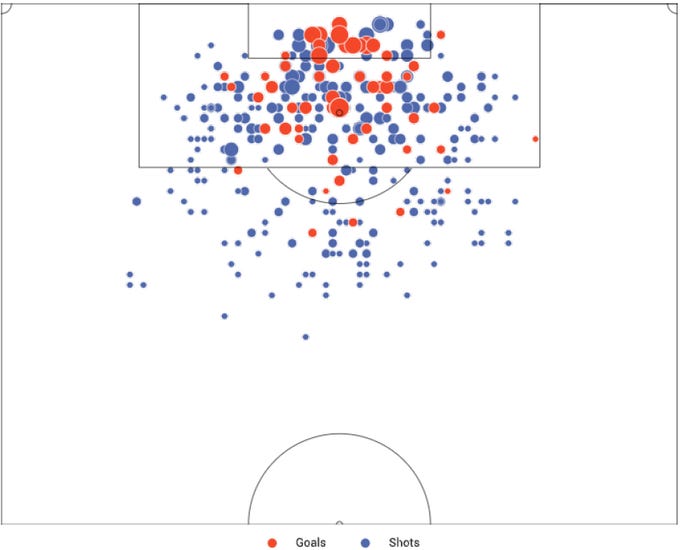
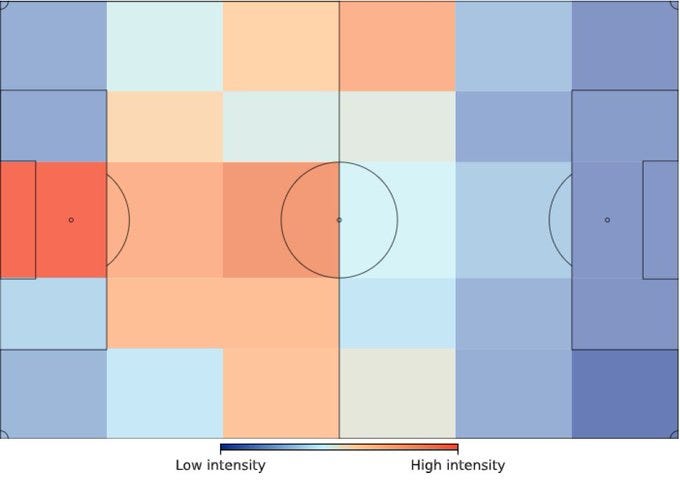
Yes, it makes sense that Sporting Lisbon experiences more vulnerability on the left side, given how much emphasis they place on that area in their attacking play. As the team often pushes the left-back (typically Nuno Santos or others) forward to provide width and support the attack, there is naturally more space left behind. This creates opportunities for opposing teams to exploit the open areas left in the defensive structure.
The left side's offensive emphasis makes it a high-risk, high-reward zone. While Sporting can generate substantial attacking threats there, the trade-off is the increased chance of being caught out defensively. Opponents may look to break through the space left by the advancing full-back, particularly when the team is committed to building attacks in that area.
This dynamic illustrates the balance Amorim has to maintain between offensive intensity and defensive stability. It's a vulnerability that often comes with a tactical style that focuses on dominating one side of the pitch, but Amorim likely compensates for it with defensive structures and quick transitions.
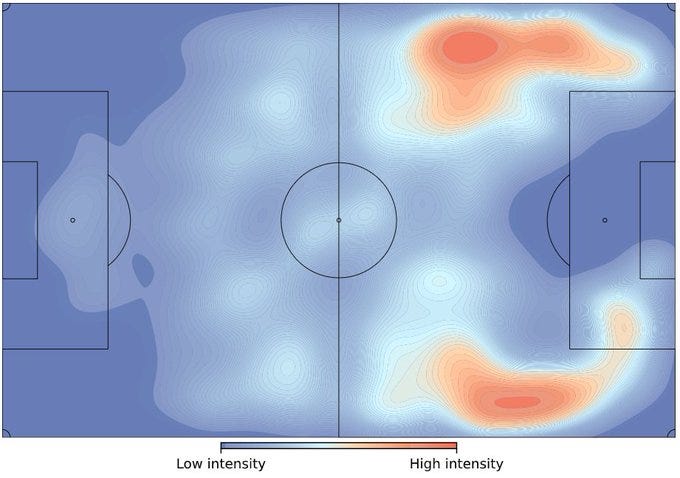
Yes, the image showing the ball recovery areas further reinforces the tactical balance Sporting Lisbon strikes between attacking and defending. The left side being the most prominent zone for ball recovery aligns with their offensive emphasis on that side. It suggests that, while they are vulnerable to being exploited there defensively, they also look to regain possession quickly in that area to launch attacks.
This dynamic highlights how Amorim utilizes the left side not just as an attacking platform, but also as a pressing zone. By prioritizing high recoveries on the left, the team tries to maintain pressure and limit opposition transitions, but the trade-off is the higher risk of being caught out when the press is bypassed.
The slightly less frequent recoveries in the central areas suggest a more cautious approach there, possibly because the midfielders in those positions are tasked with controlling transitions and covering the back line. The correlation between defensive vulnerability and ball recovery areas reinforces Amorim’s emphasis on high-pressure, aggressive play while accepting some defensive risk.
The end.
The statistical images are from Fbref and the @xfbsays account on Twitter.
The match images are from Twitter and social media platforms.