
Analyzing VfB Stuttgart's tactical play since the start of the Bundesliga 24/25
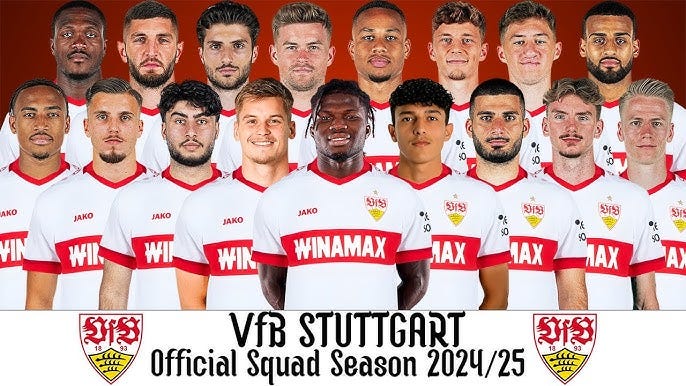
This tactical profile examines VfB Stuttgart's approach across the following phases of play:
- Defending without possession
- Transitioning from attack to defense (right after losing the ball)
- Maintaining possession in a controlled manner
- Transitioning from defense to attack (right after regaining possession)
*The analysis includes photos and videos from Bundesliga matches this season*
Out of Possession
When out of possession, VfB Stuttgart generally adopts a 4-4-2 formation. They defend high up the pitch with tight spacing between their lines, allowing their fullbacks and center-backs to press assertively and create turnovers in advanced positions.
Sebastian Hoeneß prioritizes front-footed defending. He pushes his players to take calculated risks off the ball and adopt a proactive defensive stance instead of just reacting to their opponents. This strategy is especially vital for the center-backs, who must step forward decisively to aid the two-man midfield, which would otherwise be outnumbered.
While the value of Stuttgart consistently creating high turnovers is evident, this strategy carries significant risk. A poorly timed or uncoordinated press can leave the team highly vulnerable to lateral switches of play, often exposing large gaps on the opposite side of the pitch.
No doubt, this is Stuttgart’s Achilles' heel. Opponents who can lure Stuttgart into a press and then swiftly maneuver out with precise, rapid passes can easily exploit the vast gaps that open up on the far side of the pitch. The result is a defensive scramble.
Additionally, Stuttgart’s center-backs tend to defend aggressively and push high up the pitch. This often leaves them out of position when opponents recycle possession out wide, making the team vulnerable to immediate crossing opportunities.
VfB Stuttgart exhibits exceptional intensity and energy when out of possession, applying aggressive pressure across the pitch to achieve high ball recoveries. Their center-backs play with a proactive, forward-leaning stance to reinforce this approach. The team keeps compact spacing, enabling them to press collectively as a unified unit.
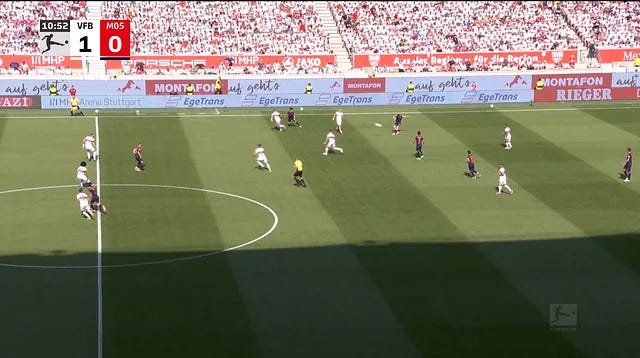
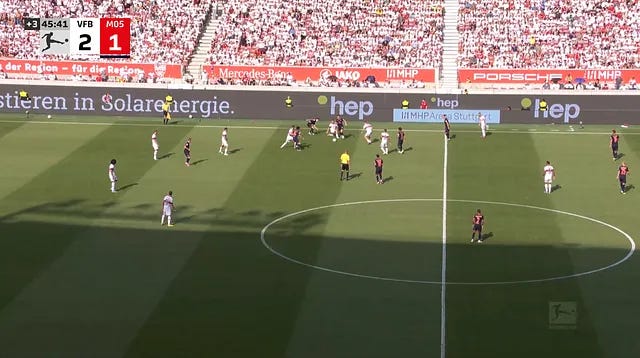
While this strategy often allows Stuttgart to suffocate their opponents, it carries considerable risks. If the opposition manages to break through the pressure, they can exploit the large, vulnerable spaces left open on the far side of the pitch. By drawing Stuttgart into pressing with short passes and then swiftly switching play to the opposite flank, teams can create high-value attacking opportunities.
here, Mainz break free from Stuttgart’s pressure, finding ample space for a 1v1 attacking duel on the far side.
Transition (In Possession to Out Possession)
After losing possession, VfB Stuttgart displays intense aggression in their gegenpressing. They immediately apply pressure to recover the ball, aiming to regain control as quickly as possible.
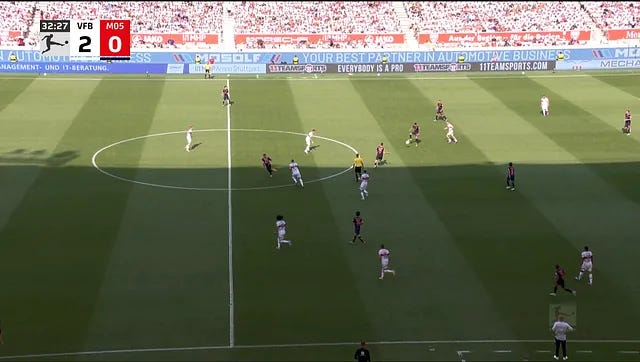
Stuttgart's aggressive gegenpressing allows them to secure high-value ball recoveries, but it comes with considerable risks. If opponents can quickly switch play to the opposite side, they can exploit the large open spaces. This is particularly problematic when a turnover occurs on Stuttgart’s left side, as Jamie Leweling’s fluid positioning often leaves the opposite flank unprotected, leading to situations where Stuttgart’s right back is exposed in a 2v1 scenario.
here, Jamie Leweling’s fluid movement into the center-forward role during possession leaves the wide areas unoccupied. As a result, a turnover can make Stuttgart vulnerable to a 2v1 situation on their right flank.
In possession
1-(Build up (1/3rd + 2/3rd)
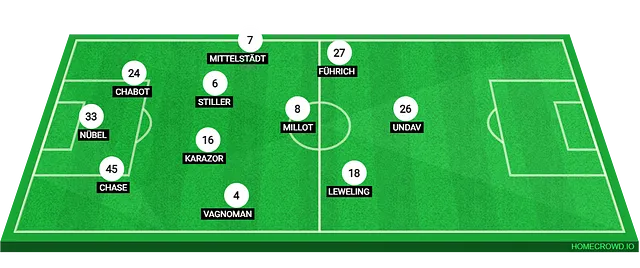
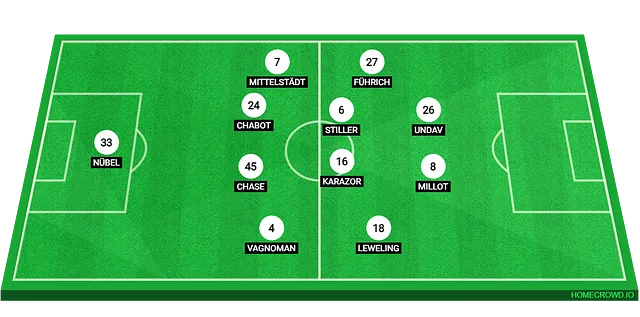
During controlled build-up phases, VfB Stuttgart often employs a 2–4–1–3 formation. Their two defensive midfielders, Atakan Karazor and Angelo Stiller, position themselves relatively wide, allowing for greater involvement of Stuttgart’s attacking midfielder in the build-up play.
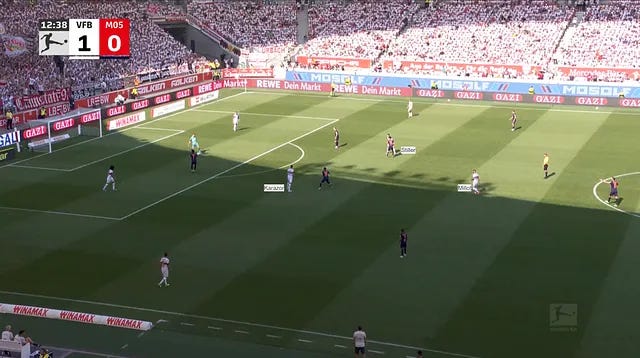
Sebastian Hoeneß encourages his team to show bravery and courage during build-up phases, with Stuttgart taking significant risks to play out from the back even under intense opposition pressure. This bold approach often lures opponents into pressing, but when Stuttgart successfully navigates this initial phase, they often gain a numerical advantage, enabling them to launch quick and effective attacks against the opposition.
Stuttgart's main objective is to progress play through the center of the pitch whenever possible. They only look to exploit the wide channels once they reach the final third.
Last season, Stuttgart stood out as one of Europe’s most impressive teams in building play from the back with confidence. However, the summer departures of center-backs Hiroki Ito and Waldemar Anton have left a significant void that remains unfilled. Jeff Chabot, in particular, has been a noticeable downgrade in possession. Although he is a strong 1v1 defender, he has struggled to meet the requirements of a high-possession style. Opponents should aim to force Stuttgart’s build-up play through Chabot to create high-value turnovers in advanced positions.
2-(Attacking Creation (3/3rd)
Stuttgart's build-up play is defined by structured and well-organized patterns, but Sebastian Hoeneß introduces a creative balance in the final third, combining positionally disciplined attacks with more fluid, free-roaming movements. This contrast is especially noticeable when comparing the functions of Stuttgart's right and left flanks.
Left Flank
On the left side, Stuttgart’s approach is marked by disciplined roles and clearly defined attacking sequences. Left-back Maximilian Mittelstädt and left midfielder Chris Führich maintain their positions on the wing, adhering closely to structured movements.
This disciplined positioning allows Mittelstädt and Führich to remain closely connected, creating advantageous 2v1 attacking situations. Their consistent presence on the left wing also helps to stretch the opposition’s defensive shape, making them a significant and often overlooked threat when transitioning into the final third.
Right Flank & Central Zones
In contrast, Stuttgart’s approach on the right flank and through the central areas is more dynamic and positionally fluid. Players in these zones frequently swap and rotate positions, reacting intuitively to available space and adapting to their teammates' movements and decisions.
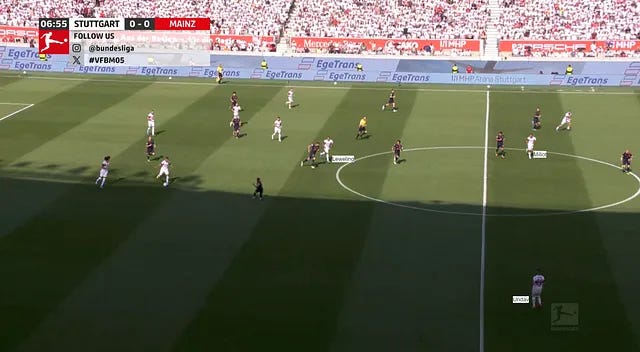
The intelligent movement and constant rotation in Stuttgart’s attack pose significant challenges for opponents, particularly through the center of the pitch. For example, when Denis Undav drops deeper off the backline, Jamie Leweling instantly moves into his position, creating a difficult dilemma for teams—such as Real Madrid—that rely on a man-oriented defensive approach in their own third.
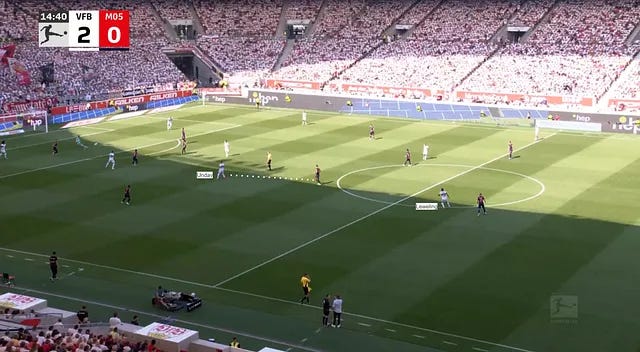
Even Stuttgart’s most traditional number nine, Ermedin Demirovic, often drops off the backline to receive and link up play. When he does, Stuttgart’s attacking midfielder—either Denis Undav or Enzo Millot—or the right winger—Fabian Rieder or Jamie Leweling—quickly moves into the vacated center-forward position. This movement engages the opposition’s center-backs and creates a direct vertical threat, making Demirovic’s link-up play even more effective.
Although the season is still in its early stages, it is likely that Hoeneß will continue to favor a balanced blend of fluidity and discipline in his attacking strategy against Madrid. This combination allows Stuttgart to create a structured form of chaos. For example, the left side of the pitch, with Maximilian Mittelstädt and Chris Führich, follows clear and defined sequences of play, while the right side is more flexible and driven by creative ingenuity.
Transition (Out of Possession to In Possession)
Upon winning possession, Stuttgart looks to launch swift attacks through daring vertical passes. Their first pass often targets the center of the pitch, aiming to find key creative playmakers like Enzo Millot or Denis Undav.
Stuttgart's strategy involves directing the initial pass to the center of the pitch, causing their opponents to collapse centrally. This shift opens up space in the wide channels for Chris Führich and Jamie Leweling, Stuttgart's dynamic counter-attacking threats. They frequently switch the ball back to these areas, taking advantage of the opponents' fullbacks, who are often still advanced from the previous attack. This tactic allows Stuttgart to exploit the exposed flanks with pace and precision.
When Stuttgart plays into these unmarked wide areas, it compels the opposition center-backs to abandon their central positions to counter the threat. This movement generates gaps in the middle, which Stuttgart can exploit, enabling their attackers or midfielders to move into these open spaces and capitalize on the disrupted defensive structure.
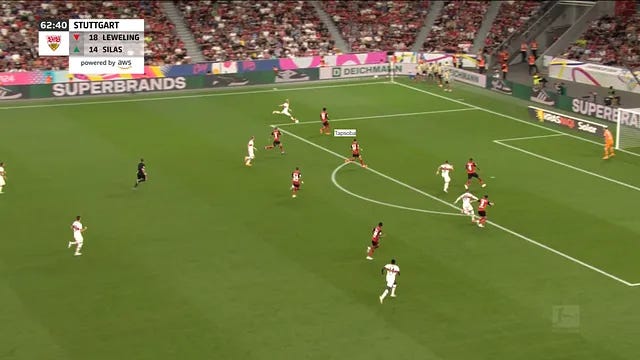
This creates significant gaps in the penalty area, allowing Stuttgart’s advancing midfielders to exploit these spaces by connecting with crosses into the box or perfectly positioning themselves to capitalize on rebounds. In such moments, Stuttgart becomes particularly dangerous, overwhelming the opposition's disrupted defense